SOC 2 Type I vs Type II Audit Timelines by Platform
Type I takes months, Type II takes longer because observation windows can't be rushed.

SOC 2 Type I and Type II measure two different things, and nearly every timeline question people ask comes down to confusing them. Type I checks whether controls are designed correctly on one specific day; Type II checks whether those same controls held up, day after day, across a window of months. That gap, snapshot against sustained pattern, explains why every phase in this piece behaves the way it does.
Both report types test controls against the AICPA's Trust Services Criteria. Security is mandatory in every SOC 2 report, with no exceptions, while Availability, Confidentiality, Processing Integrity, and Privacy get added depending on what the business does and who's asking for the report. Only a licensed CPA firm can issue either report, a detail that gets glossed over more than it should. Compliance automation platforms, covered later, gather evidence and organize paperwork, while the auditor signs the report, and any vendor pitch that blurs that line deserves a second read.
The phases of a SOC 2 Type I audit and where time actually goes
Type I breaks into three phases: readiness, fieldwork, and report delivery. Readiness covers the gap assessment, the policy writing, the actual work of building controls, and the evidence gathering that proves those controls exist. This phase runs the longest and stays the least predictable part of the whole process, and most of the delay lives here, separate from anything the auditor does.
Once readiness wraps, fieldwork runs 2 to 4 weeks according to Vanta's published documentation, since the auditor is checking a single snapshot, which is exactly why this phase stays short. Report compilation follows, and how long that takes depends on how busy the audit firm is, how messy the findings are, and how many rounds of clarifying emails get sent before everyone agrees on the wording.
Add it up: a company already running on cloud infrastructure with documented policies can land a Type I in a few months, while one still building controls from a blank page should expect closer to half a year. Preparation is where schedules quietly fall apart, one missing access review at a time, far more often than the audit itself holds things up.
Type I earns its keep in a narrow, tactical way. It produces a report fast enough to unstick a sales deal sitting in legal review, waiting on proof of security controls. Some organizations start the Type II observation window immediately after the Type I audit closes, giving Type I a second job as a launchpad into the longer engagement.
The phases of a SOC 2 Type II audit and the non-negotiable constraint at its center
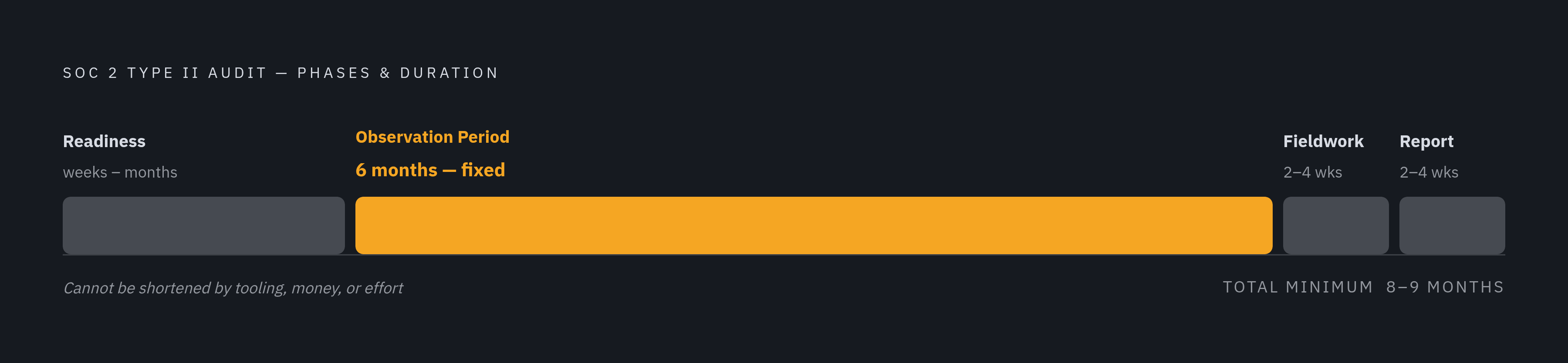
Type II adds a fourth phase, the observation period, and it sits in the middle of the process as the one step that cannot be rushed no matter how much money gets thrown at it. Readiness, observation, fieldwork, report: four steps, with the middle one standing as the wall everyone eventually hits.
Observation windows typically run 3, 6, or 12 months, and three months is the practical floor. Even that comes with a catch: periodic controls need enough time to complete at least one full cycle inside the window, or there's no evidence to hand the auditor. Six months is the common choice for a first Type II report, while twelve months is a longer window that more demanding buyers may prefer, especially on renewal.
These windows run on a fixed calendar, and time is the control here, more than effort. Vendors sell dashboards, integrations, and automated evidence pulls, and none of it shaves a single day off a calendar-based requirement. Buying more software to speed up a clock resembles buying a faster watch to make Tuesday arrive sooner, and any pitch built around that promise is worth questioning.
Realistic math: a first Type II report takes roughly 8 to 9 months from the day the engagement starts, factoring in readiness, a 6-month observation period, fieldwork, and report writing. A vendor promising a finished Type II report in under 6 months total is worth questioning closely, given that the observation period alone typically runs 6 months for a first report. Glocert International's broader analysis puts the full range at 9 to 15 months, depending on readiness maturity and observation window length, and Vanta's own customer data lands in between, averaging around 7 months for customers on its platform.
Why does observation window length become a strategic choice instead of a default setting? A 3-month window signals something different to a buyer than a 12-month window does, and which one gets picked depends heavily on what kind of platform is being audited. That question gets its own answer in the next section.
How the platform being audited shapes the timeline — the variables that compress or extend each phase
Control count drives most of the variance in audit complexity. Control counts vary considerably across organizations, and more controls means more evidence, more fieldwork hours, and a longer readiness phase, in that order.
Subservice providers add another layer, and many audited organizations include at least one third-party subservice provider in scope. Each additional vendor the auditor has to review, a payment processor, a cloud infrastructure partner, a background check vendor, stretches fieldwork a little further.
Scope itself matters just as much. Adding Availability, Confidentiality, or Privacy on top of the mandatory Security criteria (common in HealthTech, for reasons that will make sense shortly) widens the control surface and the evidence burden that comes with it. Security-only scope is the fastest route through readiness, by a wide margin, and this is where most teams get greedy, tacking on extra criteria "just in case" a future buyer might ask, instead of waiting until one actually does.
Platform maturity counts for at least as much as scope does. A company with documented policies already in place, access reviews already running on schedule, and infrastructure that lives natively in a major cloud provider compresses readiness dramatically. One building all of that from scratch faces a much longer runway that no amount of automation fully closes.
Research from Scrut Automation identified four common stall points: engaging the auditor too late, manual evidence collection eating up staff hours, scope creep as new criteria get added mid-process, and gaps in periodic controls, like access reviews that were supposed to run on schedule and didn't. Each maps cleanly onto a platform characteristic. Preparation carries nearly all the weight in these delays; platform type just determines how long that preparation realistically takes.
Timeline expectations by platform type: SaaS startups, FinTech, HealthTech, and enterprise software
A Series A SaaS startup, cloud-native with a small engineering team, can often land a Type I within a few months if infrastructure already sits inside a major cloud provider and policies exist in written form. Type II realistically needs many months from start to finish, and most startups pursue it around Series A or once enterprise deals start appearing in the pipeline. Security-only or Security-plus-Availability scope is the typical starting point, and it's also where automation platforms pay off the most, since smaller teams have the most manual work to hand off.
FinTech follows a different pattern, and treating it like a slower version of the SaaS timeline is a mistake worth flagging early. Banks and payment processors often expect more than a point-in-time snapshot, because a Type I report tells them little about whether controls survive sustained pressure. The right call, in nearly every case, is to skip Type I and go straight to Type II. A longer observation period is often preferred by financial services buyers, and a shorter window may not satisfy procurement requirements. Additional criteria beyond Security may be required depending on the nature of the services offered, adding control surface and stretching readiness further.
HealthTech tends to run a broad control scope, often covering multiple Trust Services Criteria at once. HIPAA compliance runs in parallel and competes for the same engineering and compliance hours. Readiness expands significantly under that load, and 9 to 15 months is a realistic planning horizon, not a worst-case scenario.
Enterprise software, particularly complex multi-tenant platforms with large subservice provider footprints, pushes toward the upper end of that same 9-to-15-month range. High subservice provider counts multiply what the auditor has to review, and large control counts do the same on the readiness side. Enterprise procurement teams often expect longer observation windows, so planning for a full-length period from day one is safer than defaulting to a shorter window and adjusting later.
How compliance automation platforms change the readiness phase across platform types
These platforms connect to cloud providers, identity tools, and code repositories to pull evidence on an ongoing basis, replacing the older habit of manually grabbing screenshots from a cloud console once a month and dropping them into a spreadsheet. They handle the evidence-gathering work directly, while the auditor's role stays separate, and any pitch implying otherwise is worth a second look.
The impact concentrates almost entirely in readiness. Automation can meaningfully shrink the gap between an initial assessment and an audit-ready state, though the observation period stays exactly the same length no matter which platform runs in the background, because that constraint was never about tooling to begin with.
Vanta tends to offer the fastest onboarding path for a first-time SOC 2 effort, with more than 400 integrations on offer. One documented case: the AI company Dust reached Type II audit readiness in three weeks using Vanta, with minimal engineering effort from its own team. It's a well-documented fit for US-based SaaS companies pursuing a first report, and Vanta's own customer benchmark puts average time to a Type II report at around 7 months.
Drata is another compliance automation platform designed to support organizations managing multiple frameworks at once and scaling across complex setups.
Secureframe supports a broad range of frameworks and is generally noted for its accessible onboarding experience. It suits teams moving on several certifications at once rather than one at a time.
Sprinto is a compliance automation platform aimed at startups and smaller teams, with programs structured to help move toward audit readiness. It fits first-time SOC 2 teams that need guidance nearly as much as they need software.
Thoropass addresses a related but separate problem: finding a qualified CPA firm willing to take the engagement can itself be a bottleneck, and some platforms work to reduce that coordination burden.
Some compliance tools are part of broader governance and privacy platforms rather than being built around SOC 2 specifically, and the setup overhead that comes with them tends to suit larger organizations over smaller teams optimizing for speed.
Here's the part worth saying plainly: the headline integration count on any of these platforms matters less than whether the 10 to 15 integrations that actually generate audit evidence line up with what a given company's stack looks like. A platform can list 400 integrations and still leave a company thinly covered if the tools it relies on daily aren't among them, so it's worth checking the specific list before signing anything rather than taking the marketing page's word for it.
For FinTech and HealthTech, where control scope runs widest, automation's effect on the total timeline is real but bounded. The observation period still cannot be shortened, and the evidence burden created by extra Trust Services Criteria still lands on the internal team, tooling or no tooling.
Renewal audit timelines and what changes after the first Type II report
A SOC 2 Type II report stays current for 12 months from its period end date, which means recertification happens every year, without exception. Renewal audits move noticeably faster than the first one, since controls and policies already exist in documented form, evidence collection is already running, and the auditor relationship no longer needs to be built from zero.
Twelve months is the standard observation period for renewals. Some firms offer shorter windows, but enterprise buyers generally expect full-year coverage on a renewal report and may not accept anything less.
The scheduling rule that actually matters: start the renewal engagement before the current report's 12-month window closes. Back-to-back periods with no gap is standard practice, since a gap between reports undermines the exact continuity story enterprise buyers are looking for when they ask for a SOC 2 report in the first place.
Bridge letters exist for this specific situation: a formal statement from management confirming controls remain in place while the next audit is still underway. They're genuinely useful as a stopgap, but limited in scope, and a bridge letter doesn't satisfy every enterprise procurement checklist, so it's best treated as an occasional safety net rather than a routine part of the annual cycle.
For FinTech and HealthTech platforms specifically, continuous compliance infrastructure, meaning an automation platform paired with internal ownership of periodic controls like access reviews, turns the renewal cycle into a manageable annual task instead of a scramble every twelve months.
Building a realistic SOC 2 schedule from platform type and business stage
The first fork in the road is Type I, Type II, or skip Type I entirely, and the third option deserves more weight than instinct usually gives it. Type I makes sense when a specific deal needs a report within 60 to 90 days and Type II is already on the roadmap, since the auditor can start the Type II observation window the moment the Type I closes. For FinTech, and for any team with a clear enterprise sales motion already underway, running a Type I first mostly just delays the report buyers actually want. According to a Scrut Automation co-founder citing vendor data, up to 70% of companies skip Type I altogether and go straight to Type II, which suggests most teams have already worked out what this section is arguing.
The second fork is observation period length. Three months is the fastest route to a first report but sends a weaker signal to buyers who know what a short window means. Six months is the standard choice for a first Type II, balancing speed against credibility. Twelve months is required for enterprise and regulated-industry buyers, and FinTech and HealthTech teams should plan for twelve months from day one rather than treating it as a later upgrade they'll get around to.
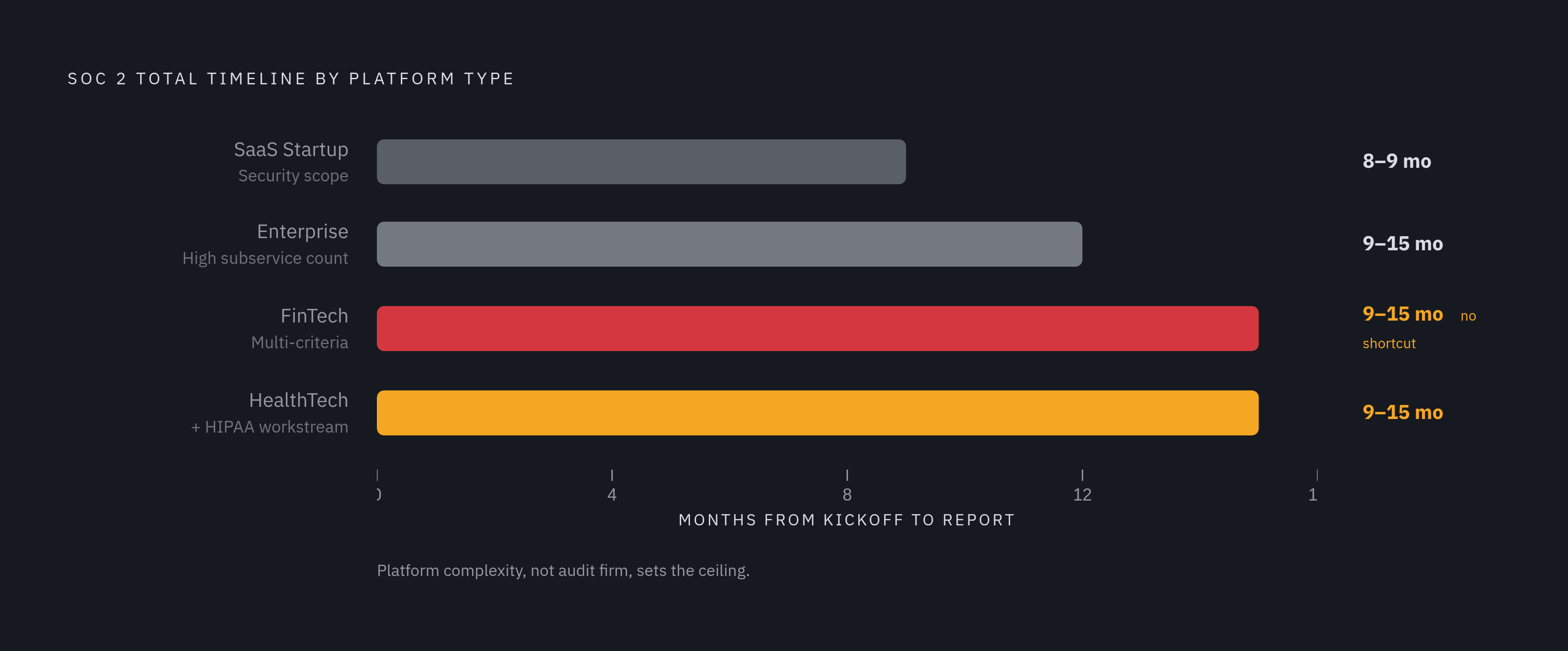
Putting the platform types side by side: a SaaS startup running Security scope with a 6-month observation window should plan for 8 to 9 months minimum, with automation able to compress readiness down to a matter of weeks for teams whose documentation is already in order. FinTech, running multi-criteria scope with a 12-month observation window, should plan for the upper end of the 9-to-15-month range, with no Type I shortcut available. HealthTech, running full criteria scope alongside a parallel HIPAA workstream, sits in that same upper range, with staff time split across two compliance efforts rather than one. Enterprise software, carrying a high subservice provider count, needs extra buffer built into fieldwork specifically, since evidence volume scales directly with how many integrations and third parties sit in scope.
Nearly everyone makes the same mistake: treating the audit phase as the whole schedule, when preparation is where almost all the time actually gets spent and where nearly every delay starts. Ownership matters here too. Marketing and sales leaders who understand what the certification timeline actually looks like can set accurate expectations with prospects and plan launches around when the report will genuinely be ready. Treating SOC 2 as a back-office concern until a six-figure deal stalls, waiting on a report that's still four months out, causes real damage that a realistic schedule set early avoids entirely.
The business case underneath all of this rests on real numbers, and goodwill toward compliance for its own sake has little to do with it. Per A-LIGN's 2025 Compliance Benchmark, SOC 2 is the most commonly pursued audit framework among organizations seeking certification, and per Gartner Digital Markets' 2024 report, nearly half of software buyers prioritize security certifications when choosing a vendor. Getting the timeline right shapes revenue outcomes directly, well past whatever value it holds as a compliance exercise on paper.