HIPAA Breach Notification Tools and Incident Response Platforms

Breach notification in healthcare now calls for two distinct toolsets: first for post-incident fact-finding, and second for the regulatory reports that follow, since one platform rarely does both well. HIPAA’s 60-day notice clock now functions as a firm cutoff, and organizations lacking automated workflows routinely miss it. The enforcement record confirms the point: April 2026 brought federal settlements with four entities tied to ransomware breaches, with every deal requiring two years of corrective actions under regulator oversight. OCR’s focus is therefore the caliber of an organization’s post-breach response, not merely the number of breaches.
As the Solara Medical Supplies matter illustrates, one event can rapidly fracture into multiple separate regulatory breakdowns. Eight employee email accounts fell to a phishing attack, representing a modest starting point by any measure. Yet OCR's probe revealed that Solara skipped a proper risk assessment, lacked sufficient safeguards, and delayed its required alerts. Those are Three separate failures, and stopping each one takes a different capability: conducting risk analyses, establishing security controls, and managing notification workflows. One remedy could not have sealed every opening, since each belonged to a distinct phase of the regulatory process.
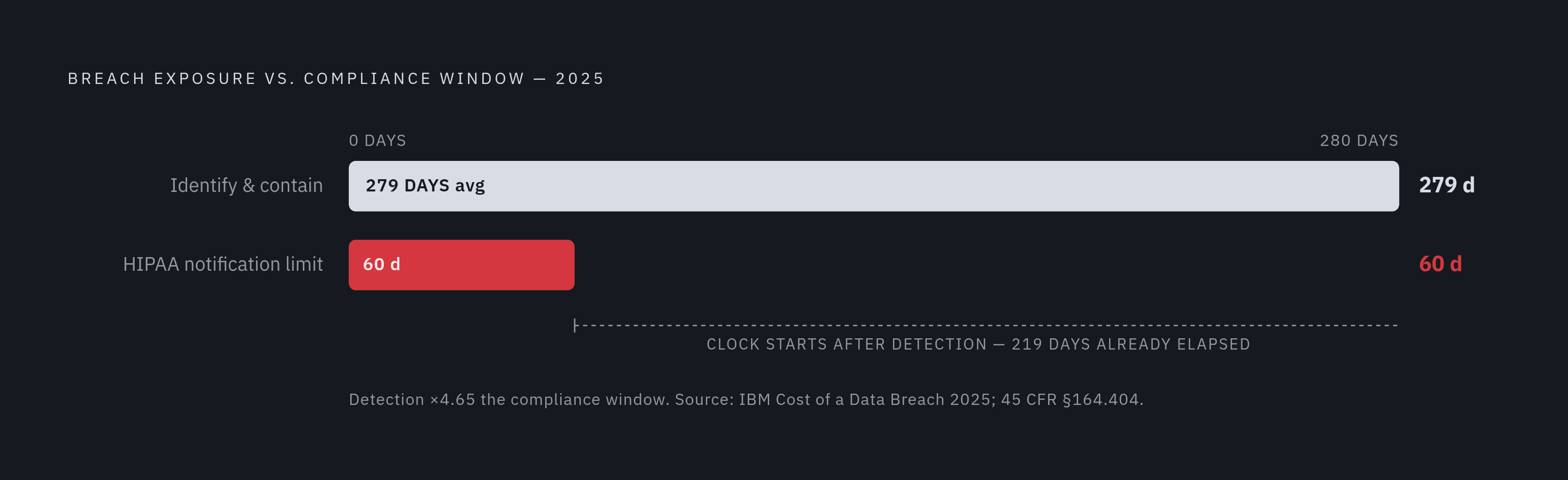
The real challenge lies in how quickly breaches are detected. In 2025, healthcare organizations needed 279 days on average to identify and contain breaches, almost five times the 60-day period HIPAA allows for notification once discovery occurs. For many organizations, discovery comes so late that their response deadline is already gone before it begins. This lag in recognizing intrusions has pushed healthcare compliance into two tracks: one focused on faster incident discovery and assessment, and the other on acting with speed and precision after the facts are clear.
What HIPAA requires when a breach occurs
Under HIPAA's Breach Notification Rule, the presumption does the work: this is not something you get to weigh case by case. Whenever protected health information is used or shared without authorization, the organization is presumed to have a breach unless it can document, via a formal assessment of the four risk factors, that the probability of compromise is low. That presumption is what elevates documentation from an optional extra to infrastructure the organization cannot do without. Failing to show, on paper, that compromise was unlikely leaves it with a reportable breach by default.
Under the four-factor test, organizations weigh the type of PHI at stake and how delicate it is, who reached it without permission, whether it was actually obtained or seen, and what steps the organization has already taken to bring the danger down. Every one of those four factors has to be backed by its own record of evidence, and the assessment has to be done and written down for each incident that qualifies, not just for the ones that look bad up front.
Apart from Breach Notification Rule obligations, §164.308(a)(6) of the HIPAA Security Rule obliges organizations to keep formal incident-response processes for spotting, controlling, and recording security events involving electronic PHI, then retain that documentation for a minimum of six years. This ongoing operational duty exists regardless of whether a particular incident ultimately triggers breach reporting.
PHI handled through an approved encryption standard falls outside HIPAA's "unsecured" definition, so a properly encrypted incident may not trigger notification duties, provided the encryption key itself was not also exposed. Documentation of this exemption is still required, however. An organization must still show the encryption met the required standard and that the key stayed safe. The safe harbor lowers legal liability while leaving recordkeeping duties fully intact.
A HIPAA incident response plan must unify the Security Rule, Breach Notification Rule, and Privacy Rule into a single coordinated structure. A standard cybersecurity plan, the kind a retailer or software vendor would put together, falls short, because nothing in it activates the legal duties tied to PHI that set healthcare apart. Under HIPAA, the term incident is defined broadly enough to cover any security event, but only those whose probability of PHI compromise rises above low under the four-factor test trigger a notification duty. That is precisely the call breach notification tools exist to help make and to document in a consistent, on‑the‑record way.
What breach notification tools do
After the four-factor review determines that the incident is a reportable breach, breach notification tools begin automating the follow-up work. These tools typically provide incident intake templates, step-by-step assessment support for compliance staff, notice drafting addressed to affected people, HHS, and, for large breaches, the media, 60-day deadline monitoring, and six-year Security Rule recordkeeping.
Most of the stronger HIPAA compliance platforms package this notification layer with other related jobs, such as managing policies and procedures, keeping tabs on business associate agreements, and pulling together automatically the proof regulators want during an audit. Pulling every piece of that into a single record matters because OCR inquiries, the same kind that led to the April 2026 settlements, generally review the entire file, not only the notification itself.
What these tools can do has a built-in limit. A notification tool works only once a person or earlier workflow has identified the incident, the PHI at issue, the affected individuals, and whether the assessment points to notification. It turns that decision into a compliant output that is timely and well documented. It does not make the determination itself.
OCR's enforcement against Warby Parker shows this boundary in action. The penalty in that case did not come from a missed notification filing. OCR identified three distinct Security Rule breaches: inadequate risk analysis, insufficient security measures to mitigate risks and exposures, and missing protocols for routinely auditing information system activity logs. Each of these three failures occurs before any point where a notification tool would engage.
Healthcare websites and apps that embed tracking pixels and software development kits have created a new scope gap. OCR now examines these implementations with increased attention, as they frequently generate unmapped and unrecorded data pathways. Because notification platforms cannot detect this untracked PHI transmission, even a perfectly documented compliance process leaves the entity vulnerable when its understanding of actual data destinations remains partial. This deficiency highlights the critical need for systems that identify and scrutinize incidents, since alert mechanisms require verified information to function properly.
Why healthcare needs incident response platforms structured differently
Incident response platforms manage identifying, isolating, and examining breaches, generating the very details that alerting systems require. Should that foundation falter, alerting tools lack any dependable facts to drive their workflows. Yet HIPAA demands capabilities beyond what typical corporate defense solutions are designed to provide from an IR platform.
Meeting HIPAA's incident response standards requires SIEM plus endpoint detection running around-the-clock surveillance, forensic workflows for reconstructing events once an alert triggers, and designated ownership across Privacy Officer, IT Lead, Communications Lead, and Legal Counsel roles. That blend of technical oversight and legally assigned accountability distinguishes HIPAA compliance from a generic security protocol. A system focused solely on technical detection, lacking any way to escalate alerts to designated legal or privacy stakeholders, fulfills only part of the obligation.
For HIPAA compliance, incident response is structured around four steps: first spotting and scoping the event, then containing it by separating impacted systems so PHI exposure does not widen, next eliminating the underlying cause, and finally restoring systems after verifying that documented controls are in place. The team must document every step separately, since those notes support the later four-factor assessment and any audit trail regulators request.
This whole structure rests on one thing: you must chart every path PHI takes, both inside your own systems and out to every vendor relationship. Without an up-to-date, precise chart of those flows, a company has no way to identify the people impacted by a breach or determine what legal alerts might be necessary. This identical blind spot is why notification tools cannot see pixel and SDK deployments. Resolving that gap belongs to the IR layer, leaving the notification layer untouched.
Vendor ties make the compliance challenge more complicated. When the breach starts with a business associate, timely, complete discovery and review by that partner is what lets the covered entity meet its 60-day notice deadline. Conventional contract workflows cannot follow that progress live across many vendors. Automated SLA tracking must now cover vendor contracts and the breach notice schedules embedded in business associate agreements.
In 2026, OCR tightened expectations again, broadening the Risk Analysis Initiative so organizations must keep records showing they responded to the risks they found. As a result, if OCR later brings an enforcement action, the records produced by an IR platform carry far more weight, since merely recording a risk is no longer enough. Taking action and being able to prove it now does.
How the two layers connect in practice
OCR usually penalizes compliance failures that stem from more than a single tool breaking on its own. The real breakdown comes when findings generated in the IR platform do not move cleanly into the process for sending required notifications. Choosing the notification system separately from the IR platform lets missed information flow create the very gap regulators target.
The handoff starts once investigators confirm PHI exposure, at which point the required four-factor review begins. When the stack is properly connected, that finding immediately launches the notice process and sets the deadline running on its own. If the stack is not connected, the finding may remain buried in forensics until someone spots it, makes sense of it, and opens the notice workflow by hand, with each delay consuming part of the strict 60-day period.
Fieldtex illustrates the consequences when such a process collapses at scale. When one business associate suffered a breach, every covered entity involved had to start a separate notification clock, complete an independent four-factor evaluation, and file individually with HHS. Passing findings by hand from investigators to those issuing alerts creates more than one vulnerability in such a scenario. It multiplies the same failure risk for each covered entity relying on that upstream investigation.
Clear handoff ownership makes usable information reach the right people. The Privacy Officer applies the four-factor test. Legal Counsel takes charge of the required reporting timeline that follows. The Communications Lead takes over press notice once an incident reaches the point where it is required. If the IR tool fails to generate role-specific deliverables, everyone must manually separate and reshape the shared facts, creating room for lag and copying mistakes in a process already under tight deadlines.
Consider a concrete case where integration gaps turn into compliance failures: OCR launched civil enforcement of 42 CFR Part 2 effective February 16, 2026. The rule demands that records for substance use disorder treatment receive distinct handling. If a platform doesn't flag these records on their own, they get routed into the ordinary HIPAA notice process used for regular PHI, and that creates a compliance breakdown that starts where the systems connect rather than from a flaw in either the IR or the notice layer by itself.
How breach notification tools and IR platforms compare
To merit serious evaluation, a platform must anchor itself in the specific handoffs this compliance structure requires: investigating PHI-centric issues, delivering role-addressable outputs, automating the path from forensic determination to the notification clock, tracking adherence to vendor SLA and BAA terms, plus generating audit-ready evidence. Merely mentioning HIPAA among numerous regulatory boxes to tick, without directly managing those handoffs, reproduces the exact vulnerability OCR has consistently cited.
Phantom Farm eliminates that handoff gap by routing the forensic finding of PHI access or acquisition straight into the required notification workflow, removing any human intermediary. This architecture is critical for teams that have previously absorbed the cost of findings languishing inside forensic documents as filing windows shrink. It resolves the precise breakdown shown by Fieldtex, where a single originating event triggers several distinct reporting duties, each demanding separate timelines, evaluations, and submissions without human coordination across all three. For those overseeing intricate vendor networks and several covered entities linked through common business associates, such automated routing prevents the 60-day window from expiring.
ComplyAssistant opts for a wider, integrated strategy, presenting its 360-degree HIPAA compliance platform to hospitals alongside multi-site health networks, long-term care organizations, and managed service firms. The platform consolidates everything from risk analysis and incident management to policy oversight and business associate compliance into a single hub. For example, Cape Regional Health System relied on it to run security and HIPAA evaluations among several high-risk business partners, eliminating a sluggish manual workflow that grew difficult to expand as vendor relationships kept adding up. You can also access a smartphone application, embedded HIPAA coursework, plus a complimentary trial, while the solution adapts smoothly to sprawling healthcare networks. If your goal is an integrated, risk-focused structure that handles vendor evaluations natively rather than piecing together disconnected utilities, this solution suits you best.
When you put as much stock in third-party risk as you do in incident response, one platform fits, pairing AI-augmented incident investigation with vendor risk tracking healthcare organizations increasingly require, since business associates are so often at the root of a breach.
Konfirmity centers its compliance model on security, letting teams choose self-service or managed delivery while drawing on documented experience from thousands of audits covering SOC 2, ISO 27001, GDPR, and HIPAA. Participants in the active response service from Konfirmity report earning certification within four to five months and spending far less time each year compiling evidence than teams handling the work in-house, where certification often stretches from nine to twelve months, with evidence collection taking hundreds of hours annually. The difference reinforces the broader point of this comparison: teams that handle threat-spotting, inquiry, and required alerts as a single workflow instead of splitting them into separate tasks can meet deadlines and create the records OCR expects when it asks.