GRC Platform Implementation Costs and Hidden Fees
Implementation and hidden fees often dwarf the license cost that buyers first negotiate.

A CFO agrees to the license fee in a proposal from a GRC vendor. It is also, nearly always, the lowest figure in the deployment's total cost. After implementation, data migration, and training are counted, license fees typically make up only between 50% and 80% of the year-one total. The two figures differ because buyers don't know what to check before they sign the contract. This happens because buyers don't know what to bring up before signing the contract.
The license fee is plain to see. Everything else tends to arrive later, in the form of invoices, headcount requests, and project delays that nobody budgeted for. The contract is already in place by the time the real scope is visible.
GRC platforms cost based on company size, excluding hidden fees
Company size gives a general range, but other things shape the price. Start there when looking at GRC pricing.
Smaller businesses below about 200 staff typically pay $15,000 to $45,000 in their first year. Mid-market organizations generally spend between $50,000 and $150,000. Enterprise deployments can run into the low millions of dollars, based on how many entities, modules, and integrations are needed.
Even at the bottom of this compliance-automation tier, entry-level platforms like Vanta, Drata, and Secureframe prove how far pricing runs. Vanta contracts span $7,500 to $56,781, sitting close to $20,000 in the middle. The bottom and middle figures are miles apart, showing how these contracts get priced: not from a set menu, but by mixing headcount, standards, plus modules negotiated as add-ons case by case.
For GRC buyers more broadly, contracts typically run from $6,143 up to $49,000 per year. It's a big range for a category built around the same basic job. That variance is driven by pricing models. Some vendors charge by user, some by standard, some for each integration; a buyer looking at offers together may be seeing unlike pricing logics and not realizing it.
Buyers in Europe follow the same pattern, just at other price points. Mid-market deployments run roughly €45,000 to €120,000; enterprise suites pass €250,000 once modules, per-seat fees, and implementation are stacked on the base license.
Implementation fees showing up as the biggest surprise charge
Consulting fees in enterprise GRC implementations regularly run $200,000 to $500,000, with that figure climbing higher still in more complex environments. GRC work for large companies often costs between $200,000 and $500,000, with tougher cases costing more.
Professional services, not the license, often make up more than half of total implementation cost. Buying data points to adding a 200 to 300 hours block of setup work to the license deal before sign-off, so unexpected bills don’t arrive later.
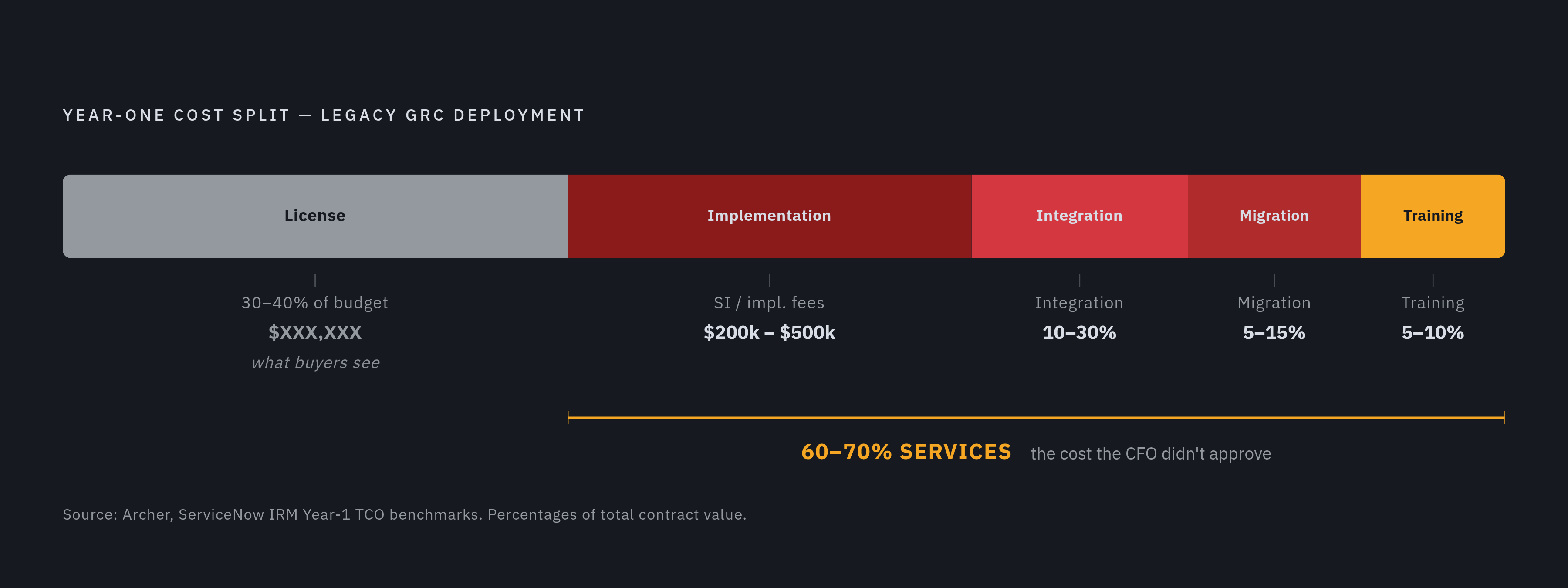
On legacy platforms, the gap actually grows. With legacy platforms like Archer and ServiceNow IRM, a Year 1 budget allocates 60% to 70% toward services out of the total, with only 30% to 40% going to the license itself. Roughly the reverse of what the original proposal implies, with the license placed up front and the services line treated as an afterthought.
The IRM side of ServiceNow puts the spending in clear numbers. The base license costs $150 to $300 for each seat monthly. Implementation costs and admin retainers add another $200,000 to $500,000 or more. For a typical contract term, the three-year total cost of ownership for a mid-market enterprise can climb to several times the first-year spend. That total isn't on the sheet quoting the per-user license fee.
The cost categories that appear on invoices after the contract is signed
A few categories turn up in almost every deployment, with roughly the same proportions across vendors. Take this set of items to the vendor meeting.
Data migration costs 5% to 15% against total contract value and affects organizations most when they leave legacy platforms or spreadsheets, because the data structure fits less cleanly into the system's schema. Integration, linking the platform with HRIS, ERP and ticketing, runs 10% to 30% of contract value by itself; standalone integration can put $5,000 to $50,000 more onto the Year 1 spend, beyond the base contract. Training costs typically run an extra 5% to 10% of contract value. Buyers usually think training comes with the license. Buyers routinely assume the license bundles training, but it almost never does.
These categories are all standard. They turn up in nearly every legacy or modern GRC deployment. The buyer either prices these categories in before signing or finds out about them from an invoice three months into the rollout.
Internal headcount: the cost that never appears on any vendor invoice
Some GRC platforms assume a specialist, not a generalist, runs them. Instead, they target a dedicated operator who knows the platform's configuration setup, designs the required frameworks, runs workflow rules, and stops the system from falling out of sync with how the organization actually runs things.
Hiring a GRC professional at that level means paying a salary well into six figures a year. This cost doesn't touch a vendor invoice or show up in the proposal from that vendor, and it stays out of the buyer's model too, because headcount absorbs it instead of linking it explicitly to the platform.
Complex legacy deployments may require additional dedicated administrators to stay operational. This introduces a vulnerability often missed in procurement: the departure of a single administrator can bring the entire system to a halt. It can stop dead in its tracks, because how the platform was set up usually sits in one or two people's minds and nowhere else.
Renewal pricing and the Year 2+ cost escalation most buyers don't model
The worst blow usually lands at Renewal, slipping by a year or longer after people stop thinking about the initial contract conversation. Renewal quotes in the GRC category can see significant increases. Anyone working on 2026 budget should anchor that conversation to the renewal figure, not the initial invoice.
Typical agreements include annual renewal increases. Compounded over a three-year term, renewal escalations can significantly increase total costs. Annual maintenance fees, which run 17% to 22% of the license cost, escalate through compounding just like the license itself does. Maintenance costs rise right alongside a figure the buyer assumed was set.
The chance for negotiating all this closes once the contract is in place. Ceilings on yearly jumps, extension rules, and what pushes rates higher (more people, extra tools, added offices) must be agreed on before signing. Waiting for the renewal notice to raise these questions means negotiating from a position with far less leverage, since switching costs by that point are already baked in.
Platform migration as a cost multiplier when switching vendors
Most buyers assume switching vendors will help them drop a costly setup. But migration itself usually drives the highest cost across a platform's entire lifecycle, and buyers underestimate it more than anything before getting started. The big bill comes from migration work, from integration rebuilds, from retraining people on different software, and from time spent with both platforms active, all missing from the original spreadsheet.
Most of that cost comes from running both systems at the same time. During a migration, a company keeps the legacy platform running so it can reach past data, while the replacement is configured and checked in tandem. Double license fees and duplicate overhead pile up while staff divide their time between maintaining the legacy platform and setting up its replacement. All of it is required, and all of it takes time.
Lock-in just compounds things. On legacy platforms, Proprietary data formats and customization make migration harder and add cost as the original deployment becomes more customized. The deeper a platform is tailored to how an organization's workflows run, the more time and money it takes to switch.
For organizations with many accounts or entities, including MSPs and regulated groups with subsidiaries, costs climb quickly. Each move charge repeats for every customer or entity under management, pushing expenses upward with portfolio breadth and the intricacy of the system being swapped out.
How Platform setup affects structural and avoidable hidden costs
Platforms don't all hide costs alike, and that traces to the platform's original architecture, not just the pricing.
Legacy platforms like Archer, OpenPages, MetricStream, and ServiceNow IRM run steep license fees plus systems-integrator costs that regularly top the license itself. Configuration often falls to an outside expert, not the in-house admin, while time-to-value typically ranges from twelve to eighteen months between contract and deployment. At this tier, hidden costs are not just a pricing quirk. That’s structural to the platform’s design.
Hyperproof, Drata, and Vanta are modern cloud-native platforms on the opposite side. License costs typically fall between $7,500 and $25,000, systems-integrator fees stay minimal or absent, and time-to-value runs 1 to 3 months. The tradeoff is limits: these platforms come with lower hidden costs, but leave narrower scope to customize a complex, multi-framework setup.
AI-native enterprise platforms form another category that aims to bridge the gap. Sierra shows this approach, with no SI charges for a typical setup and many built-in connections ready from the start. This tier aims for a faster time-to-value, trying to deliver enterprise-grade tools under a modern cost structure instead of the legacy one.
They cover different questions, so treat them as different checks. IBM OpenPages ranked as a Leader in the GRC Tools, Assurance Leaders 2025 Gartner Magic Quadrant, reflecting the platform's capabilities, not how predictable total cost of ownership is for a buyer.
Another cost category is just forming: agentic AI is becoming a defining force in 2026 GRC, so buyers drafting a shortlist must find out if this kind of AI-powered automation comes with the base license or shows up as an extra tier. It could turn into a hidden-cost category of its own, the way migrations and integrations turned into hidden costs ten years back.
A simple check resolves this ambiguity for the most part. Require every shortlisted vendor to supply a three-year total cost of ownership model covering systems-integrator fees, integrations, internal staffing, yearly maintenance, and renewal escalation. Vendors with a setup that holds these costs down will go through the model without hesitation. Vendors whose platform costs run deep usually push back on it, since this review pulls out the figures the first proposal never showed.
Building the total cost model before the contract conversation starts
Use the vendor proposal to build a cost model. This habit separates buyers who stick to their numbers from those who go over.
Cost buckets must be completed before any contract is finalized. The platform license takes priority, accounting for projected renewal escalation and how it compounds over a three-year horizon, factoring in far more than the Year 1 figure shown. Next are Implementation and systems-integrator fees, budgeted for legacy platforms at 50% of Year 1 cost or more, with significantly lower fees for modern cloud-native architectures. Next come integration, training, migration, and module fees; treat the vendor and procurement benchmark percentages as a minimum, not a maximum, because costs regularly exceed them. Internal headcount comes next: how many people the platform will realistically need as dedicated GRC administrators, priced at salaries instead of absorbed silently into department budgets.
A few negotiation levers shift these figures more than anything. Asking at least 3 vendors typically gets discounts of 20% to 32% below the standard rate. Folding 200 to 300 professional-services time directly into the opening agreement curbs the trickle of Year 1 surprise line items. The highest-leverage choice most buyers pass up is Negotiating renewal escalation caps during signing, before the renewal notice.
Have the vendor conversation only after the total cost conversation, not before. The figure on the proposal wasn't the one that mattered.