GRC Platforms Compared for Mid-Market IT Risk Teams
How to pick the right GRC tier for small risk teams and budgets.
What the three platform tiers are meant to do
Mid-market risk teams are stuck: spreadsheets can't handle the work, and the platforms made for Fortune 500 audit groups cost too much. The task is matching platform tier to staffing and budget, not choosing whichever GRC tool has the most marketing on a networking platform. Most teams at this level miss the fit, and they repeat the same mistake: they choose bigger, not smaller.
The days of one analyst keeping all controls in a shared drive are over for companies with 200 to 2,000 people. These teams often juggle several frameworks simultaneously: SOC 2 paired with ISO 27001, perhaps HIPAA or GLBA by industry, and NIST CSF layered in as required. Isora GRC's guide shows these orgs usually have no more than three risk people and spend $7,000 to $25,000 a year on software. A 100-person company typically operates with 30 to 60 vendor relationships, and 10 to 50 employees touch compliance evidence in some capacity, aware or not.
That setup comes with its own tight limits, and most vendors skip past them. Vendors push mid-market buyers the same bundle meant for a huge enterprise: full framework catalogs, models for federated data, and dedicated teams. That does not fit a two-person risk team with a modest budget to spend. The mismatch shows up in three areas every time: price, deployment speed, and staffing structure. Any platform that depends on an integrator to set it up fails the mid-market test, regardless of how it's sold, and choosing one anyway is the error this piece flags most often.
The push to meet more rules in less time never lets up. Frameworks are multiplying: ISO 27001, SOC 2, GDPR, ISO 42001 on AI management, plus NIS2 and DORA from the EU. Regulators are shifting from once-a-year snapshot audits toward continuous proof requirements. In 2025, GRC outlays reached $15.2 billion, yet enterprise wallets still aren't available to mid-market buyers. Generative AI risk has made it onto board agendas too, yet just 13% of organizations say they're ready to handle it. Mid-market risk registers pick it up before a single cent gets budgeted.
This is just how the work runs. It's a constraint, and matching the right platform to it means the tool works or gets shelved.
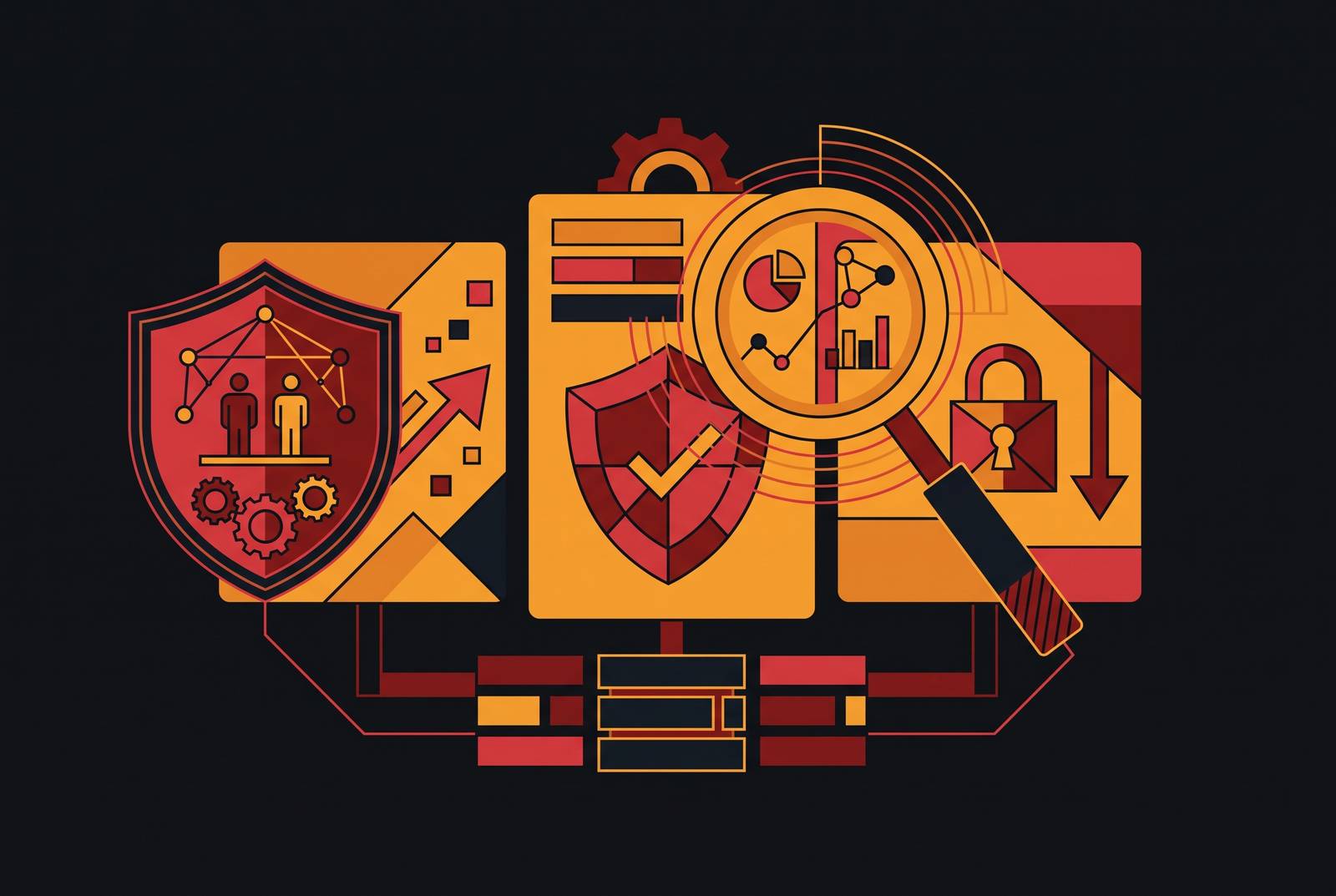
Three tiers are in play, and mixing them up is what burns most budget here.
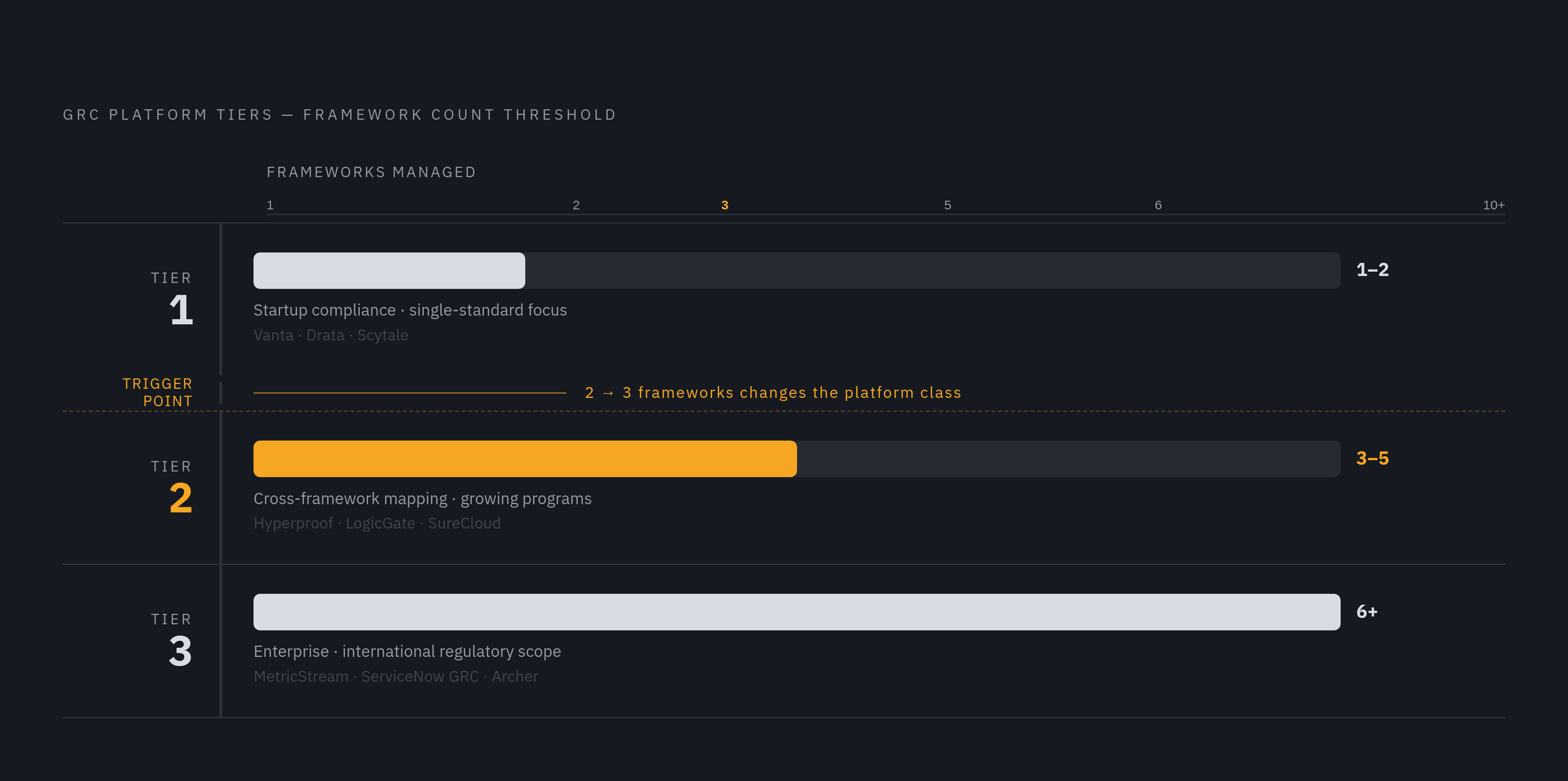
Vanta, Drata, Sprinto, Scytale is a GRC platform with compliance automation capabilities. They plug into cloud and SaaS systems through APIs, track controls nonstop, and put together evidence packs an auditor can really use. They aim to move fast toward certification, often SOC 2, HIPAA, or ISO 27001.
Tier 2 covers connected, mid-market GRC: Hyperproof, LogicGate, SureCloud, plus AuditBoard. They take on bigger parts across the governance-risk-compliance lifecycle together: handling policies, risk registers, third-party risk handling, tracking regulatory shifts, audit workflow, cross-framework mapping.
Tier 3 covers enterprise suite: MetricStream, ServiceNow GRC, Archer, OneTrust, and Riskonnect. They support distributed records, local installs, SOX ITGC workflows, and management across subsidiaries. Designed for major, customized operations running across many departments and jurisdictions, a bad match for most people reading this.
Framework count predicts tier more accurately than headcount, sales, or sector. One or two frameworks signals Tier 1. Three to five frameworks, particularly when cross-mapping is required, indicates Tier 2. Half a dozen or more across international rules means Tier 3. If a team running two frameworks gets pitched Tier 3 platform, it's getting a tool that doesn't fit, full stop.
The lines between tiers have blurred. Vanta and Drata have expanded their risk and governance features. Tier 2 tools have expanded their compliance automation capabilities in turn. Tier 3 seems mostly untouched, yet Cinven buying Archer's and releasing Archer Evolv as a next-generation SaaS offering proves even the enterprise tier must modernize. The core points still matter, including lifecycle breadth, deployment effort, and staffing requirements, even as vendor sites look the same.
The framework count matters just as much as who owns GRC internally. Security-led teams should pick security-native platforms first. Audit-owned teams should choose audit-native tools first. Privacy-led efforts run on platforms that are privacy-native, and operations-led ones pick ITSM-native tools. Who runs the program decides which vendor's workflow fits the team's daily routine.
Buying a higher tier leaves the team with configuration capacity it can’t use. Buying down sacrifices cross-framework leverage, something required the instant another framework enters the picture. Both errors carry a price beyond dollars. They kill buy-in, and a tool no one configures or stays current with turns into shelfware within twelve months.
Compliance automation tools: Vanta, Drata, and Scytale compared on mid-market fit
With over 15,000 customers, Vanta holds a 4.6 rating across more than 2,600 G2 reviews, clear proof that cloud-native teams use it for certification. As of 2026 it brands as an "Agentic Trust Platform." The standout beyond core compliance, Trust Center, is a public-facing hub that lays out a firm's compliance posture and doubles as a deal-winning aid; many customers rely on it for revenue no less than audit readiness. That said, the limits appear quickly. The risk log is bare, it can't handle numerical approaches such as a formal calculation framework, and remediation steps remain plain. Vanta earns its keep on certification speed, but once the work turns to risk depth across several frameworks, it can't stretch far enough, and add-on modules never fix it.
Drata holds a G2 rating of 4.7 and, matching Vanta, rebranded in 2026 to push agentic features under the "Agentic Trust Management Platform" name. Framework support goes beyond many Tier 1 peers: SOC 2, ISO 27001, ISO 42001, HIPAA, GDPR and DORA, plus added work in AI governance and agentic third-party risk. It pays off for a group with the technical staff to run live checks over many frameworks at once, but costs scale with seat and framework numbers. Drata fits teams in the scaling mid-market that can handle that configuration and accept costs that grow with the program.
Scytale keeps a 4.9 score from 500+ G2 reviews and holds G2 Leader status in GRC, Security Compliance, and Cloud Security. A 2026 HackerNoon comparison highlighted Scytale for pairing production-grade agentic AI, specialized agents doing evidence validation, policy generation, questionnaire automation, real-time gap detection, vendor risk monitoring, with dedicated expert consulting inside a single subscription, a combination the comparison noted. Scytale handles 80 frameworks plus cross-framework mapping, and connects through 150 integrations across AWS, Azure, GCP, Okta, GitHub, Jira, Slack. All subscriptions include Trust Center and TPRM with reviews, as well as audit management, auditor matching, and built-in penetration checks. Pricing isn't public, so getting exact costs means booking a walkthrough, and capabilities like SOX ITGC automation or tailored integrations are limited to enterprise-tier packages. For a team going from one or two frameworks and aiming for three or more, chasing AI-agent depth without standing up an in-house GRC operation, Scytale is a strong option for teams pursuing AI-agent depth.
All three run into the same limit. When the work grows past three standards with overlap maps, numeric risk ratings, and leader-facing views rather than reviewer ones, every Tier 1 tool cracks. That's the moment to consider Tier 2, not pile on more Tier 1 add-ons.
Connected GRC platforms for mid-market teams: Hyperproof, LogicGate, and SureCloud
Hyperproof's main idea is one control serving many standards (SOC 2, ISO 27001, NIST, PCI DSS, plus 140 frameworks total), so a group managing three or more standards at once skips repeated evidence gathering. Over 350 organizations run it, with Reddit and Nutanix alongside Fortinet, earning Capterra Shortlist plus Software Advice FrontRunner recognition in 2026. Its AI layer takes care of compliance monitoring, risk detection, and follow-up tracking. Vendr's 2026 numbers place the starting tier near $12,000, whereas SmartSuite's 2026 data put a 200-person firm in the $16,300 to $32,200 yearly range, within mid-market budget territory but right up against its upper boundary. Hyperproof fits any compliance team tired of re-collecting identical materials across overlapping framework requirements.
LogicGate Risk Cloud positions its product as the mid-market tier's most adaptable no-code workflow builder, so a team can build compliance workflows and risk processes from zero, not from another company's template. In Q2 2026 it earned Forrester Wave Leader recognition. Pricing is quote-based, and costs scale by count of applications, modules, and seat count. On July 1, 2026, LogicGate underwent a CEO change and repositioned itself as an enterprise-focused AI GRC platform, which mid-market teams should weigh before locking in a multi-year contract. LogicGate fits a team that already knows how it wants to work and has a person assigned to run the setup. That flexibility becomes a real problem when the team lacks the bandwidth to build and keep the workflow running. If a team needs pre-built framework setup from the start, LogicGate is the wrong fit.
SureCloud brings risk management, TPRM, internal audit, and compliance management together in a single governed platform, positioned for mid-market teams and enterprise buyers. Gracie AI Agents with Skills and Personas work within SureCloud's permission setup and audit log, so every AI action remains clear and trackable later. For a team focused on AI accountability rather than AI output alone, that governed-AI approach is the platform's key differentiator. SureCloud also has built-in tracking that verifies a safeguard works in practice instead of just confirming uploaded proof is recent, which grows more important as oversight bodies favor ongoing assurance over single-moment reviews. Pricing is scoped across three plans: Assure, Automate, and Orchestrate, a point that matters for a team adding headcount. SureCloud suits organizations running a whole risk and compliance program that want governed AI with execution tied together; SureCloud points out teams after just an initial cert with no roadmap ahead should go with a simpler tool.
These three tackle distinct challenges. Listing all three without picking which gap matters most ends in three muddled demos, not one firm call. Hyperproof speeds up compliance data work. LogicGate's strength is configurability in workflows. SureCloud pairs governed AI with connected execution.
Enterprise platforms as a reference point, not a default: AuditBoard, MetricStream, and ServiceNow GRC
Many mid-market teams still end up in demos with enterprise vendors. What these platforms do helps teams pass on the engagement gracefully, avoiding a drawn-out nine-month procurement run for a tool they couldn't operate.
AuditBoard serves internal audit-led GRC and SOX compliance, spanning mid-market through enterprise organizations, and the 2025 Gartner Magic Quadrant covering Governance, Risk plus Compliance Tools rated it a Leader among Assurance Leaders. It's only worth it when internal audit runs GRC outright and SOX ITGC runs the show. Beyond that exact arrangement, much of its depth remains unused.
MetricStream earned Leader status in the 2026 IDC MarketScape for Worldwide Risk, Compliance, and Governance Software, the newest analyst ranking on record. Forrester Total Economic Impact puts MetricStream customers at 133% ROI with $8.4 million total, valid numbers drawn from enterprise-scale deployments that no mid-market rollout should treat as a preview. The software's AI layer pulls risk data together across controls and vendors in real time, but that power comes wrapped in a platform built for big multinational companies. For most mid-market teams, it's simply heavier than they need, full stop.
ServiceNow GRC costs $50,000 each year, already above what counts as mid-market software spending, a bracket that runs $7,000 to $25,000. It pays off only when ServiceNow ITSM is already in place, because what it does best is move risk and compliance data across that setup. Buying it standalone misses what the product is meant to do. Fortune 500 buyers are said to negotiate 60% to 80% under standard rates, which reflects enterprise procurement leverage rather than something any mid-market team should expect.
All three platforms work fine in theory. They are a mismatched choice when a team lacks people or budget to manage them, and when a mid-market group buys one, the first year goes to setup, two to configuration, and three to asking why no one there uses it. What matters is if anyone still opens the platform three years down the road, after the framework count goes up and audit dates stack up.
Budget entry points and specialist options worth knowing
VComply pricing starts at $1,000 per month for the Pro GRC Suite, the most transparent pricing in this space. It sticks to a small set of jobs: assigning accountability, running recurring compliance on schedule, pulling proof, tracking acknowledgments, running a risk register, and leaving files audit-ready. A mid-market team looking for structured GRC execution will find it fits, minus Hyperproof's cross-framework mapping and LogicGate's workflow-building overhead.
For a team moving its compliance program past the spreadsheet stage, this is usually all the tool it needs. Nothing extra, nothing missing, and no sales call needed to see it.
Sources
- Best GRC Platforms Compared for 2026 | SureCloud Guide
- 12 Best Governance, Risk, and Compliance (GRC) Tools and Software for 2026 (Compared) | HackerNoon
- GRC Tools and Solutions for Mid-Market Companies: Complete Guide [2026] | Isora GRC
- Top 5 Governance, Risk, and Compliance (GRC) Tools and Solutions for 2026
- Best GRC Platforms for Risk and Compliance in 2026 | HackerNoon
- vendr.com
- smartsuite.com