ISO 27001 vs SOC 2 Certification for US Software Companies
Choose SOC 2 first for US markets, ISO 27001 for Europe, but plan for both.
This instinct runs totally backward: Companies choose ISO 27001 or SOC 2 believing one appears more rigorous. Rigor isn't what the decision is really about. What matters is who makes the buying rules where you sell, and most young SaaS firms get both after about two years anyway. Arguing over this wastes minutes the sequencing puzzle can't spare: which comes first gets dictated through where money lands, full stop, rather than whichever framework looks stronger for sales collateral.
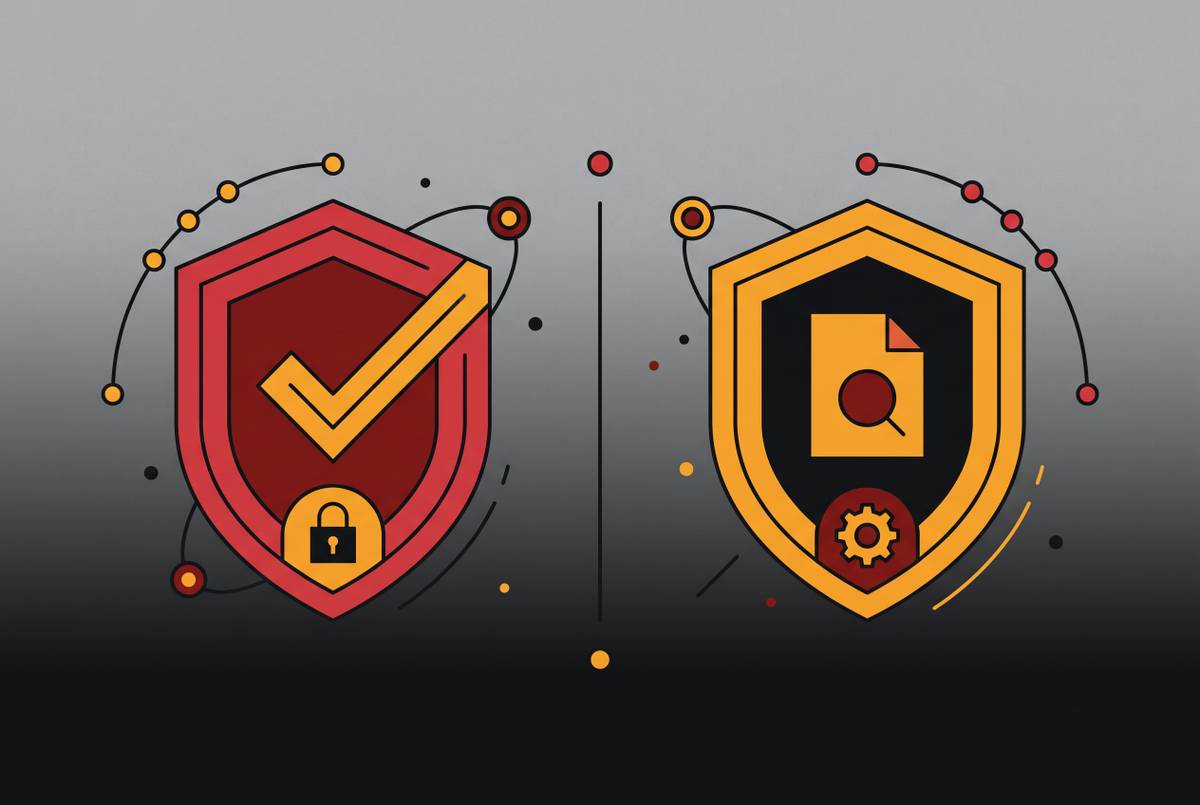
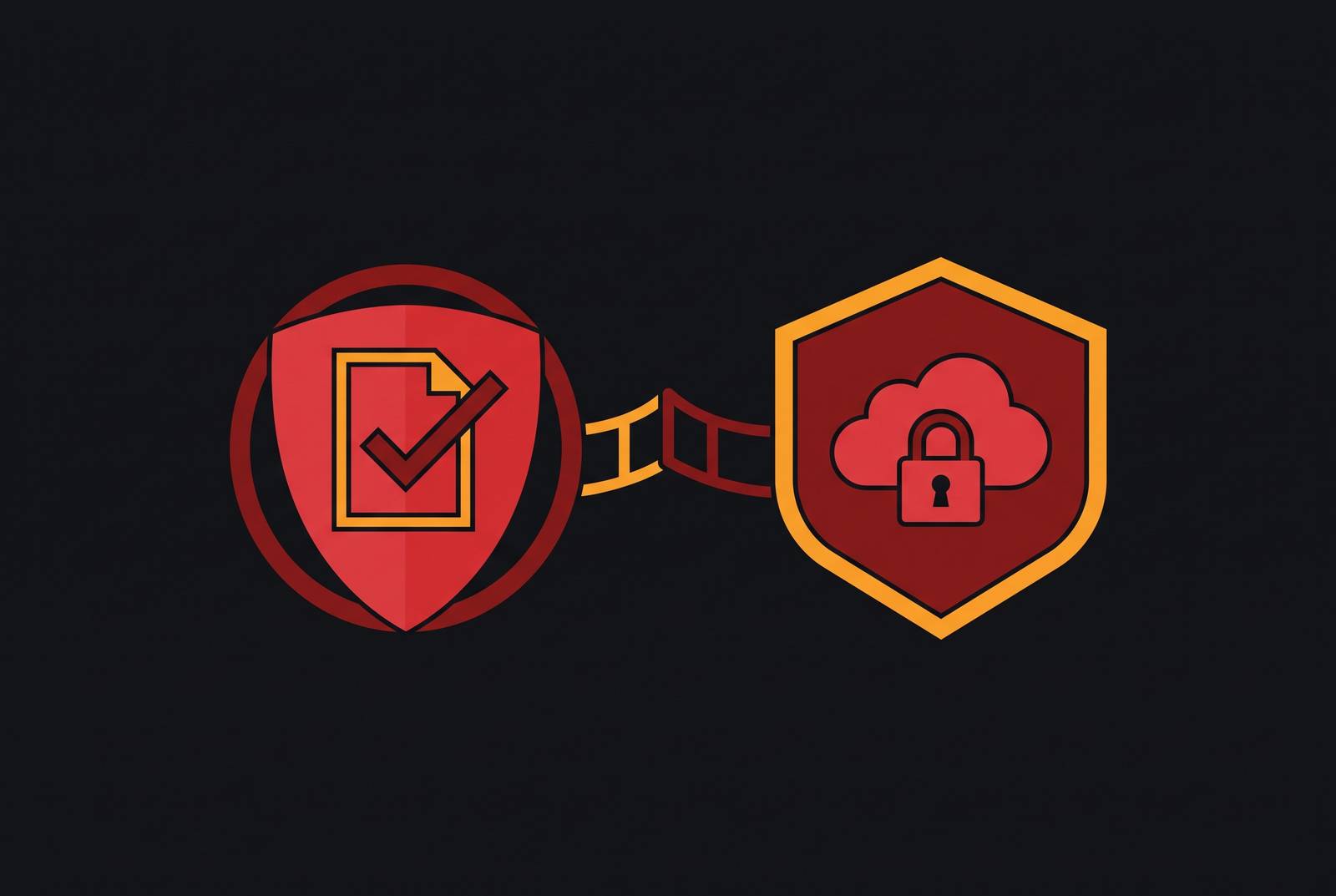
Start by looking at the process, since it shapes what comes next. AICPA created SOC 2 as an attestation framework. An approved CPA group evaluates your controls, producing a report instead of any certificate. Under ISO/IEC sits ISO 27001; an accredited certification assessor evaluates it and the result that comes back is a certificate. It can feel bureaucratic when procurement wants the certificate, sales gives its report, and your deal stalls because of an issue not flagged early. Regulators, Buyers, and auditors treat the two results in distinct ways, shaping which checkbox for procurement each satisfies.
SOC 2 evaluates controls using the Trust Services Criteria: Security is required, while Availability, Processing Integrity and Confidentiality, with Privacy, stay optional and set by the company. SaaS companies usually pick the trio of Security, Availability, plus Confidentiality, since Processing Integrity along with Privacy mostly apply to platforms handling health-data or money processors. ISO 27001 takes another approach. The company must stand up, operate, and make an ISMS (Information Security Management System) continuously better, defining its own scope, whether all operations or one offering.
SOC 2 can bend in ways 27001 simply can't. Controls can be shaped around the scale of any given company and how it runs, whereas ISO 27001 treats five-person startups the same as a logistics outfit with sites across continents. SOC 2 shows that controls were working in a set period. ISO 27001 shows the management system governing those controls maturing from audit to audit, indefinitely. One checks the work. When sales teams treat these two interchangeably, they end up misrepresenting the deal for any buyer, while the other builds company accountability.
Within SOC 2, a distinction exists that's worth naming, one many founders miss the first time around. For Type I, the report assesses controls: whether the setup is sound on one date. For Type II, checks show if those measures worked in practice across 3 to 12 months. Rightly, Enterprise buyers care much more about Type II, since Type I just tells you that paperwork was right when submitted. When any vendor opens with Type I for an enterprise deal, it arrives only half-prepared; security reviewers can tell.
How geography and buyer type determine which credential actually opens doors
In America, SaaS and software buyers expect SOC 2 as standard. Enterprise procurement teams plus vendor security reviews demand it automatically, while a vendor arriving without one ends up cut from that shortlist before the bid is even evaluated. The risk isn't some hypothetical you can dodge. Many US firms purchasing software now require this, so leaving it optional can kill deals early in the sales cycle.
ISO 27001 matters more abroad, especially for Europe, Asia-Pacific, plus regulated industries globally. Lots of European firms require the certification outright, and a few refuse a SOC 2 report instead, full stop.
For any US-headquartered firm, the answer is simple. When US enterprise buyers dominate, SOC 2 unlocks things right away. In regulated markets or the EU, ISO 27001 carries the weight, since SOC 2 by itself falls short. When your market spans both, the key call is just the order. Overlap exists: many US buyers allow an ISO certificate, and plenty among non-US buyers allow a SOC 2 audit report. Still, your primary-market choice comes down to where the money is made.
DORA began enforcement in January 2025, making this a hard requirement rather than a hint. SaaS firms selling to EU banks face more pressure to earn two credentials, because DORA treats ISO 27001 as a minimum requirement.
A growing SaaS business may receive a pair of buyer requests within days, making it feel almost routine. A big enterprise buyer in the US wants a SOC 2 audit report. The second comes from a European buyer wanting ISO 27001 certification. Both deals wait until security answers which framework to pursue, and that choice defines the coming twelve months of compliance effort.
Why the 70–90% control overlap makes dual certification the realistic endpoint for most growth-stage companies
The frameworks share a large number of controls between them. Scrut places the common overlap roughly between 70 and 90%; CBH figures on a range of 65 to 75%. What matters is the trend: once your first framework is done, a second one takes much smaller spending than starting two from nothing. Companies handling the two as distinct efforts, each with separate teams and its own timelines, re-buy evidence already in hand, and the waste is self-inflicted, not unavoidable.
User management, breach handling, system checks, plus vendor security reviews belong across the two frameworks, with evidence from one pass often satisfying the two auditors. These two diverge over the message each one sends. SOC 2 tells buyers their controls worked consistently over the observation period. ISO 27001 tells any buyer that this company uses a risk-based, structured system to keep security running all the time. You need both to fully cover the picture.
Companies with a GRC platform in place, logging shared controls just once rather than rebuilding evidence collection per framework, substantially shrink the incremental effort behind the second certification. That mechanism, not some abstract debate about which framework is better, is the actual driver behind the "which one first" question. The one your active deals need right now comes first.
That order-of-operations sequence makes sense. US customers dominate, so begin with SOC 2. EU-focused, ISO 27001 comes first. Selling to both, start with what the largest open deals require, then get a second credential across a six-to-twelve-month window.
The order matters beyond just pace. Once ISO 27001’s formal system is in place, adding SOC 2 later is usually simple because the core records and checks are already there. Going the other way, SOC 2 first and ISO 27001 second, usually means more rework, because SOC 2 never forced the company to build a formal management system in the first place. For any company already sure it wants both, this sequence is backward and shouldn't be hedged.
What each certification realistically costs and how long it takes in 2025–2026
First-time ISO 27001 certification runs $40,000 to $180,000 or more, and typically takes nine to eighteen months, according to Atlant Security. SOC 2 Type II costs between $30,000 and $150,000 plus and takes about six to 15 months, according to that report. Per StrongDM, ISO 27001 typically runs 1.5 to 2x as much as SOC 2 does, though company scale and how ready the internal staff already is can move that figure.
What wrecks timelines is those internal hours rather than any auditor invoice, and that's what companies chronically underestimate. Initial ISO 27001 efforts typically take 200 to 500 personnel-hours. Companies spend 150–400 hours on their first SOC 2 Type II effort, according to Atlant Security. Engineers plus IT personnel and security leads get pulled away from real jobs so they can gather evidence, write up policies, then sit during interviews they wish to skip, yet the consultant's bill never reflects any of it.
Quick timing favors SOC 2 when companies have deals stalled without a report. Type I usually wraps up in twelve weeks, sometimes sooner; an organized company can reach attestation in as few as 45 days. ISO 27001's initial certification cycle typically takes 6 to 12 months, so a company betting on ISO to unblock a Q2 deal has already lost that bet before it started.
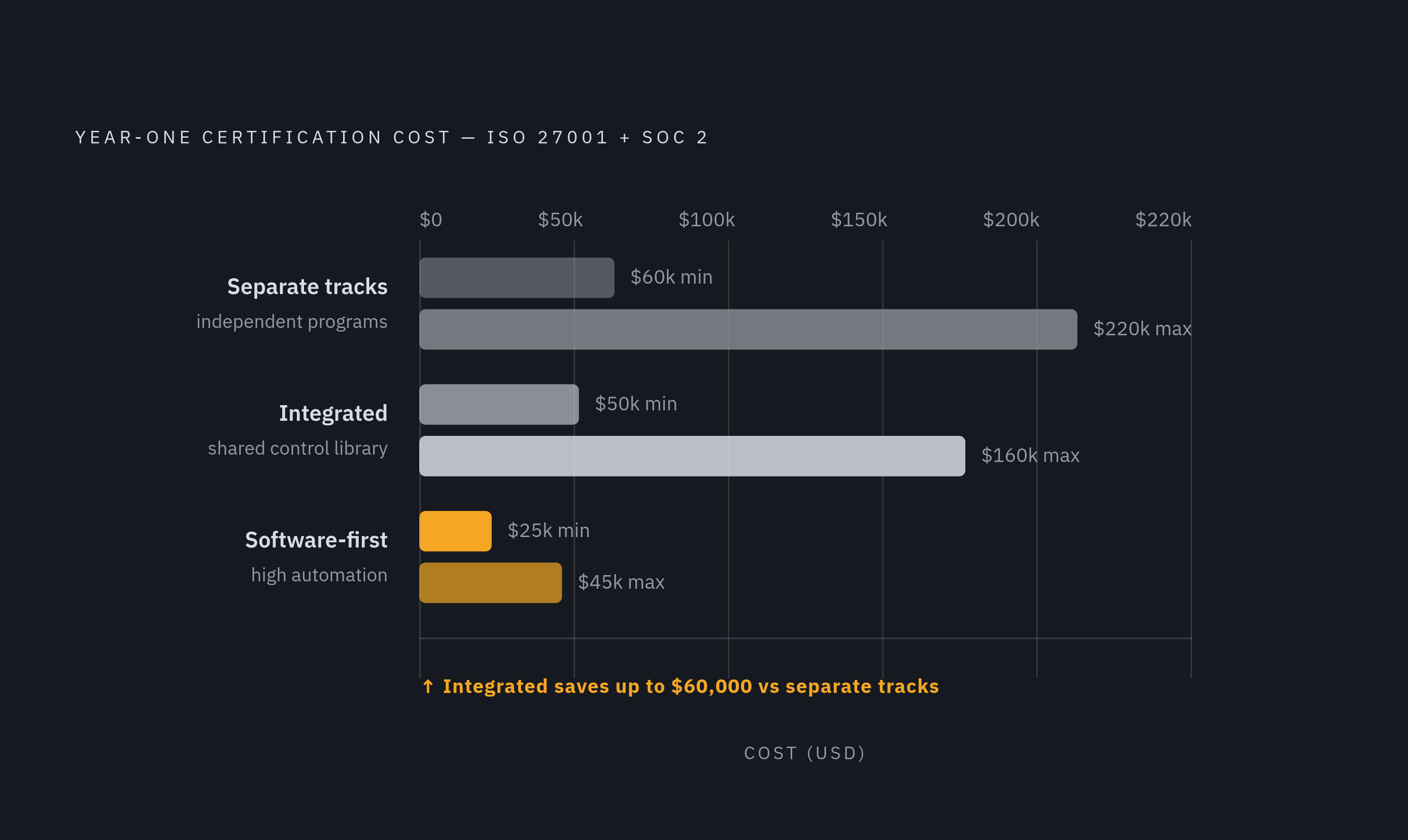
Going for both at once, the figures point to the right choice. Running ISO 27001 and SOC 2 off a shared control library costs an estimated $50,000 to $160,000 all-in for both, in the first year, according to Riskwatch. Handling each on its own track is between $60,000 and $220,000, according to that same report. Once you compare the two figures, no argument supports staying unconnected. According to Compliance Stronghold, a software-heavy route might deliver both for between $25,000 and $45,000: the software runs $12,000 to $20,000, the SOC 2 review costs $5,000 and $10,000, and ISO 27001 sign-off $10,000 to $15,000. It’s the high-automation case, not the price for any full consulting engagement, where conflating both makes budgets go off track mid-project.
Lowerplane says Automation platforms drop spending 60 to 80 percent. Named platforms in this space include Vanta, running $10,000 to $15,000 a year, Sprinto at roughly $6,000 to $25,000-plus annually with a median near $15,000, along with Drata and Secureframe. Pairing any of these platforms alongside a $5,000 to $10,000 audit gives you the speediest route to your first SOC 2 attestation right now.
The price of an audit by itself rarely wrecks a schedule. What wrecks your schedule is internal hours, so any spending plan ignoring them is a fantasy.
The ISO 27001:2022 update and emerging AI governance requirements that change what auditors expect in 2026
The ISO 27001:2022 update trimmed the controls to 93, from a prior 114, and brought in controls for cloud security, threat intelligence, and data masking. Every certification now uses the 2022 standard, full stop. Businesses running on the 2013 version needed to make the switch by October 31, 2025, and that date is done. In 2026, whoever kicks off an ISO 27001 effort follows the new rules automatically, exceptions don't exist, and no one gets grandfathering.
With SOC 2, no official criteria from the AICPA cover AI yet, but probing by auditors now targets those controls within the current framework: model access, training data security, and output monitoring. Any SaaS company that ships an LLM can expect its auditor, right now, to dig into model risk controls and AI vendor assessments, plus shadow AI detection, not just the standard technical checks. Companies that hold off until the AICPA makes rules official will face an auditor mid-audit with no ready replies, and that is the absolute worst time to learn you are missing controls.
Since its January 2025 start, DORA's enforcement has pushed dual-certification hardest among SaaS firms that serve EU financial institutions. DORA plus NIS2 treat ISO 27001 like a baseline, tightening how compliance rules shape certification decisions in ways not seen until recently.
SOC 2 is moving toward continuous compliance, tied more closely to rules including HIPAA and GDPR, plus DORA. Upcoming examinations may rely on real-time evidence rather than periodic sampling, requiring stronger supply-chain assurance.
Heading into 2026, what truly matters is the framework performing strongest under real-world conditions, not the one that reads as future-proof. The real question is whether your compliance setup going up right now will absorb those AI governance requirements once they solidify, instead of tearing everything down to begin again.
How certification functions as a sales asset and shapes enterprise deal velocity
Many large companies count SOC 2 among contract requirements, and won't work with a provider without an up-to-date audit or a match such as ISO 27001. A confirmed Type II SOC 2 report clears an early objection in any enterprise sales cycle long before it ever comes up. Show up to the vendor security check without it, and your deal won't get rated. The deal is shelved indefinitely, and the vendor may go weeks without learning why.
Big companies now demand proof of information security just to get considered, since their outside management rules keep getting harder, rather than treating it as a way to pick between the last few options. That trend resets the timing on certification: putting it off until a deal needs it leaves you six months behind.
ISO 27001 serves a like purpose in deals across borders. Procurement teams across European plus Asia-Pacific markets expect this certificate to show a structurally solid security setup that outside experts have verified.
With both, your sales asset compounds. A vendor that can put a SOC 2 Type II report and an ISO 27001 certificate on the table in the same conversation clears US and international procurement requirements at once, instead of hitting sequential blockers deal by deal, region by region.
A second effect deserves a name, and most compliance groups leave it out. A US software company with published, verifiable certifications generates factual, citable claims that AI answer engines pick up when buyers search things like "SOC 2 compliant software" or "ISO 27001 certified cloud tools." Compliance credentials work as both a sales trust signal and an anchor for AI-search visibility. Teams handling software clients can use tools to see how companies appear in AI-driven search results, and treat compliance pages and certification announcements as trusted high-authority signals for visibility.
All of it falls apart if that certification sits hidden in some compliance folder no one opens. You need it on your trust site, referenced when filling out security questionnaire answers plus in the material buyers review before any deal hits the shortlist.
A decision framework for choosing which certification to pursue first
Stop hunting for the better of the two frameworks. There's no reply worth getting. Truly satisfying each is the long-run aim; right now, what matters is only which comes first, shaped by the markets a company serves and what those buyers check off on a procurement checklist in hand.
The choice splits cleanly by main region. Start with SOC 2 Type II when Selling mostly to US enterprise buyers. That route takes less time, and procurement teams look for that credential, where Type I is attainable inside 4 to twelve weeks; Type II can take roughly two to about six months when you’re ready. Start with ISO 27001 when your buyers are mostly EU and APAC ones or similarly regulated regions, since SOC 2 can't satisfy procurement terms that explicitly require the ISO credential. Selling across US and foreign markets, or working toward overseas growth on a set schedule, start with what the biggest deals require, then bring in the second framework sometime between six and twelve months, as the control library from the first program's stays current and staff remembers where the evidence is kept.
Young businesses find SOC 2 easier to tackle initially because no full management system must exist before any review begins. When cash is short, most teams start with SOC 2 Type I, then shift to Type II after the audit window closes.
Whichever framework you tackle first, set up the shared control library immediately. There's no good argument against it: structuring evidence collection around that 70 to 90 percent overlap means the second certification costs a fraction of what starting from zero would.
Most SaaS companies at the growth stage save money by using a compliance platform alongside a separate auditor rather than signing on for full consulting work. Consulting earns that price only if internal security maturity stays weak, or regulated-sector requirements bring demands one platform won’t cover.
Whichever framework comes first, if your tool relies on LLMs alongside extra AI parts, prepare now to face auditor scrutiny over model risk controls plus vendor assessments. That attention is here to stay, and no single certification will keep it at bay.
Firms chasing big deals across the US plus Europe simultaneously, or selling to EU banks after DORA passed, have the best reason to tackle both standards at once. Going with a shared library cuts total first-year spending to around $50,000–$160,000, compared with $60,000–$220,000 for keeping both tracks independent. That difference is enough to end any argument.
Most fast-growing software companies wind up holding both certifications. The real question right now is which comes first and when; whether the second ever arrives isn't the point.
Sources
- ISO 27001 vs. SOC 2: Key Differences and When You Need Each
- SOC 2 vs. ISO 27001: differences, similarities and standards mapping
- SOC 2 vs. ISO 27001: Key differences, overlap, and how to choose
- atlantsecurity.com
- ISO 27001 vs. SOC 2: Understanding the Difference | StrongDM
- compliancestronghold.com
- compliancestronghold.com