Lightweight GRC Tools for Startups Without a Dedicated Risk Team
Startups can now run compliance and risk management solo with the right lightweight platform.

What "lightweight GRC" means and what it doesn't
In 2025, GRC spending reached $15.2 billion, and what it really shows is this: a startup founder or ops lead can take on compliance and risk management with minimal team support. Tools shaped around that constraint pulled it off. Until recently, that just wasn't realistic. A startup held off until headcount made a compliance role make sense, or it faked audits with spreadsheets.
GRC is three connected tasks handled in one place. Governance sets the rules and overall course. Risk management rates risks before they become problems. Compliance shows adherence with evidence an auditor can review. Without one platform, those three functions hit a predictable mess: teams duplicate evidence-gathering, control gaps stay unnoticed until an audit surfaces them, and a check meant for three days stretches far longer since no one holds the master record.
"Lightweight" means choosing certain trade-offs on purpose. Getting started takes days, nothing longer. The frameworks a startup will use, GDPR, HIPAA, ISO 27001, SOC 2, are pre-built, not assembled from zero by a paid expert. Pricing isn't set up for a ten-person security team to absorb the cost. The tool plugs into what a startup already has, its cloud, its repo, its sign-on, its team messaging, with onboarding and audit management built in, without making the startup work around the software.
People in this category make the same early mistake: they treat lightweight GRC like a nicer spreadsheet. 60% of GRC users still handle compliance by hand in spreadsheets, and this is the baseline the category was made to wipe out, not gently fix. It isn't a tool made for one audit and silence afterward. A platform that gets an organization through its initial SOC 2 audit and then goes silent saddles it with a new mountain of tech debt the instant an additional framework or a larger enterprise deal lands. Go with a tool that continuously automates evidence collection, catches control gaps ahead of an auditor, and reduces security questionnaires to work an AI agent can complete quickly. Everything else is the same manual grind with a prettier face.
The seven tools that genuinely fit a lean startup's constraints
Evaluate this category on these points: getting a first audit done fast, upfront pricing instead of "call us," whether the tool covers a standard SaaS setup, real AI automation versus manual checkbox busywork pretending to be AI, plus a support model made for a buyer with no compliance team. At most of these startups, that person is the buyer.
Vanta works for startups plus fast-growing firms pursuing SOC 2 and ISO 27001, letting them juggle several frameworks at the same time using cross-mapped rules. It connects to 400 integrations and more, handles 35 frameworks plus, and applies upward of 1,200 automated checks to keep control oversight active. Vanta's AI Agent handles management, evidence review, and questionnaire answers, while a human reviews the results at critical points rather than rubber-stamping everything the model produces. Over 16,000 companies depend on it, which gives it the broadest reach in this segment, and in 2025 IDC MarketScape put Vanta on the Leader list for GRC Software. For enterprise buyers, its Trust Center plus Questionnaire Automation shorten security checks, which counts when a prospect's security team wants documentation no one had ready. Governance falls short of what enterprise platforms provide because Vanta puts audit readiness first and risk management second. Pricing is quote-based, similar to Secureframe and Drata.
Drata is ideal for mid-market US firms looking for hands-on support and polished dashboards through their first audit. The platform handles SOC 2, HIPAA, GDPR, HITRUST and other frameworks. For teams new to formal compliance, what sets it apart is having a customer success manager: structured onboarding brings a business to audit-ready sooner than self-service tools typically do. Pricing generally runs from $10,000 to $15,000 annually. There are trade-offs too: first-timers face a steeper climb, Vanta offers more integrations, and governance workflows focus primarily on audit readiness.
Sprinto serves early-stage startups seeking first SOC 2 status or certification for ISO 27001 on startup funds, not enterprise money. Pricing is structured without seat-based fees, covering the program with optional add-ons for additional frameworks or features. Startups with basic cloud setups pay $6,000 to $8,000 annually, most spend between $8,000 and $10,000, and overall pricing falls between $6,000 and $25,000 driven by how many frameworks and regions are involved, undercutting Vanta and Drata on the same scope. Staff security education and vendor management are included in the core offering. It has fewer integrations than Vanta or Drata, though it covers most startups' cloud and SaaS connector needs. Sprinto says it is the first Autonomous Trust Platform in the world, with continuous compliance checks rather than periodic reviews.
What AI now lets these tools do for a solo compliance effort
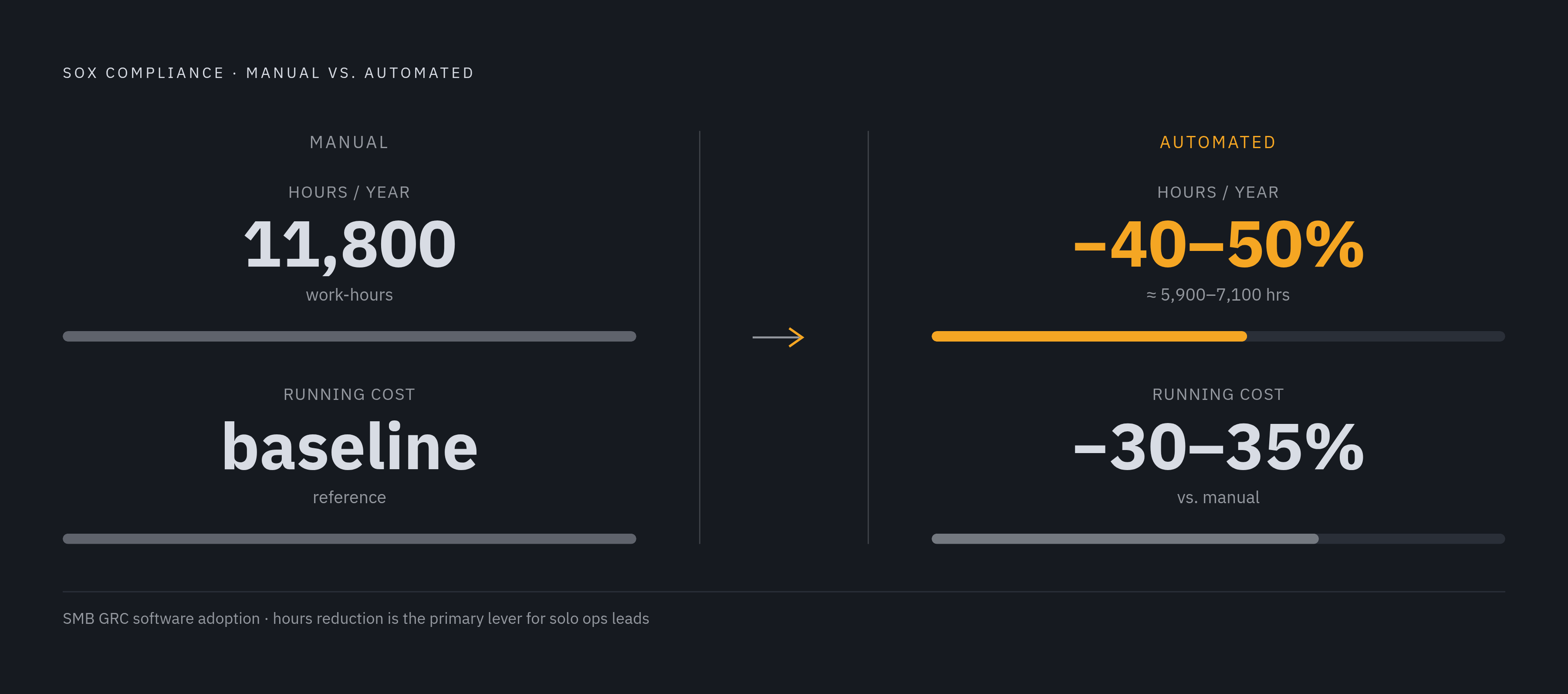
SOX compliance can take about 11,800 manual work-hours per year in a standard program. Agentic AI is bringing those hours down, letting a single ops lead now plausibly run the whole program instead of keeping someone on payroll for it.
Three tasks that once fell to a human now run through automation. Evidence collection runs continuously, drawing from SaaS tools and the cloud a business already links up, rather than getting assembled from quarterly screenshots no one remembered to grab. Gap monitoring catches a weak control before any auditor spots it, so the repair lands in a regular sprint rather than triggering a scramble mid-audit. Vendor risk forms that once dragged on through long message chains with a buyer's staff get filled out in moments by AI built on an organization's own policy set.
SMBs on GRC software cut compliance hours by 40 to 50 percent and day-to-day running costs by 30 to 35 percent versus doing it by hand. That gap leaves compliance running quietly so it doesn't burn a founder's schedule every three months.
AI is a double-edged sword in this case, fixing one problem while creating another. Over 80% of employees turn to AI tools their employer didn't sign off on, while no compliance framework shaped around spreadsheets and quarterly check-ins could spot that hidden activity. Baked-in outside AI leaves holes a young company's GRC platform must track, even when it lacks the power to fix them alone. Changing answers, unfair results, hidden records, a system that gives no reason for its call, and plain AI hype belong in every review, not rare problems. Inputs get poisoned, and an unexplainable output means no one can reconstruct the audit later. Tighter rules already sets the starting point with GDPR, CCPA, and HIPAA, while the EU AI Act goes higher: its main provisions are set to take effect in 2026, carrying costs up to 7% of turnover or €35 million, whichever stings more.
The selection criteria that matter when the buyer is also the operator
Enterprise GRC tools exist to deliver defensibility and depth during an audit. A startup buyer wants different things: fast setup, light overhead, and a tool they can run without bringing in an expert. Copying a tool simply because a fellow founder praised it on air leaves most startups with a poor fit. Working through the depth-versus-speed balance is what gets the choice right.
Pick the right framework before chasing framework count. Know which one or two frameworks matter to the enterprise customer or investor, likely SOC 2 Type II, HIPAA, or ISO 27001, and avoid breadth nobody's requesting. Cross-mapping starts to pay off as soon as a second framework shows up: tools that reuse evidence between frameworks keep the workload from doubling. Startups selling into the EU or building AI products need NIS2 and DORA, plus EU AI Act support, on the checklist from the start, not bolted on once a customer's team raises it.
Pricing transparency shows if a team can plan accurately or gets an invoice ambush later. Per-seat pricing hits a growing team hard, while a flat-rate or company-size plan like Sprinto's is much simpler to budget around. Check the starting package versus any billed add-on charges before vendor review, since platforms may show close prices for much less or more work; if unchecked, the base-plan-versus-add-on setup produces mismatched comparisons, with identical-looking deals carrying unlike tools. If penetration sits on the roadmap already, bundling can meaningfully cut costs versus getting it on its own down the line.
Pick a support model based on what the team already knows about compliance, and be honest about it. For its first formal compliance program, a team should prioritize a platform that includes a customer success manager plus structured first-audit hand-holding, as some platforms offer. A team led by engineers that prefers self-serving aligns with thorough onboarding and a broad integration library it can set up mostly alone. For a cash-tight, cloud-based business under 200 people, cost structure and built-in learning can make some tools the clear place to start, before any sales meeting is booked.